
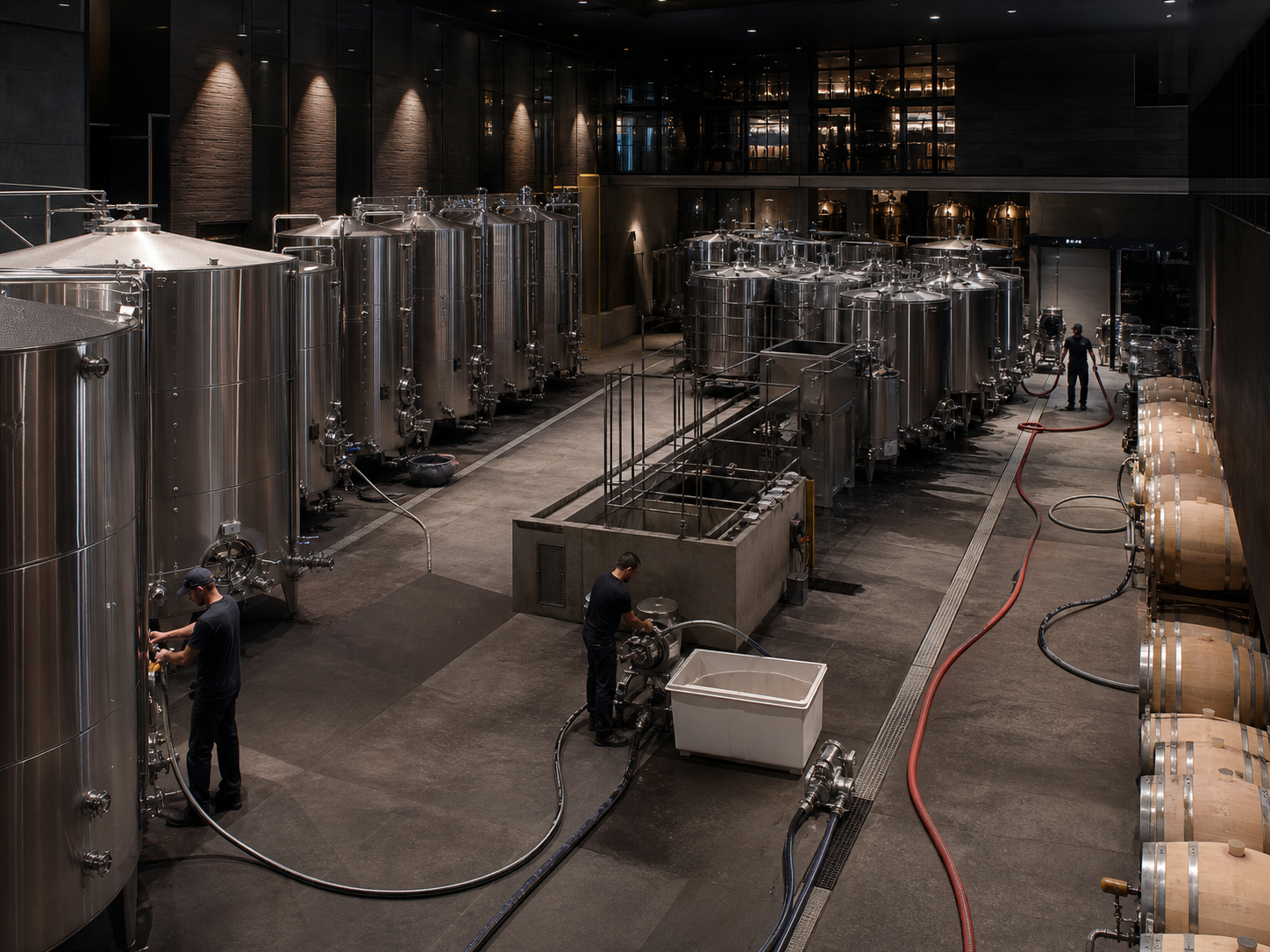
Working winery cellar with tanks, transfer paths, and production movement.

Winemaking

It’s not that it’s too big. It’s that everything happens at the same time.

You want growth — without letting complexity take over the cellar.

The real pressure

The problem is not growth itself. It is that growth makes the cellar harder to read.

Scale is not simply more wine, more tanks, or more space. It is the moment when movement, access, timing, cleaning, and decision-making begin to compete for the same cellar.

A small cellar can often run on memory. As the work grows, memory becomes a weak operating system. People wait for the same space. Transfers overlap. Cleaning blocks the next step. Active tanks multiply the number of moments that need judgement.

Scale & Operational Flow is about keeping the cellar readable under load.

Cellar pressure

Where complexity starts to take over

01

Harvest congestion

At harvest, every path starts asking for the same space.

Fruit, wine, people, pumps, hoses, cleaning, and waiting time can all arrive in the same narrow window. The issue is not only whether the wine can be moved, but whether the transfer path keeps the next decision clear.

02

Cellar readability

As the cellar grows, it has to explain itself faster.

A larger cellar can still feel small if people cannot see how the work should move through it. Equipment position, circulation, catwalks, piping, visitor paths, lighting, and cooling infrastructure all shape whether the cellar feels organized or crowded.

03

Fermentation load

More active tanks mean more simultaneous judgement.

When several tanks are active at once, fermentation becomes a scheduling and access problem as much as a tank problem. The team has to know where attention is needed without losing the rhythm of the rest of the cellar.

04

Condition stability

Scale makes every small instability louder.

As the cellar becomes busier, temperature response, holding time, transfer timing, and operator rhythm can start influencing one another. Stability has to be part of the operating flow, not a separate technical layer.

Olavin response

How Olavin keeps the cellar readable

The response is not simply to add capacity. It is to organize equipment, tanks, platforms, cooling, movement, access, and presentation as one operating environment.

Capability

Cellar Design

Production and architecture as one system.

Olavin integrates equipment, tanks, catwalks, piping, cooling infrastructure, visitor movement, working access, and lighting so the cellar can grow without becoming unreadable.

Explore Cellar Integration →
Capability

Process & Transfer Systems

Cleaner movement and fewer bottlenecks.

Transfer routes, cleaning access, pump and valve interfaces, and operator movement are treated as production design requirements, not afterthoughts.

Capability

Fermentation Systems

Clear access under load.

As active tanks multiply, fermentation access, judgement points, and process boundaries have to remain legible for the team.

Capability

Thermal Control Systems

Condition stability under higher cellar activity.

Temperature behavior, holding time, tank role, and production timing are planned together so activity does not amplify condition drift.

Owner lens

Growth should increase capacity, not coordination pressure.

Expansion should create a stronger winery, not simply more equipment to coordinate. The owner’s question is whether the cellar can grow while remaining readable, efficient, and valuable as a space.

Decision context

The decision underneath scale

The winery is not deciding whether it is large enough. It is deciding whether the cellar can stay understandable when more wine, more people, more movement, and more timing decisions happen together.